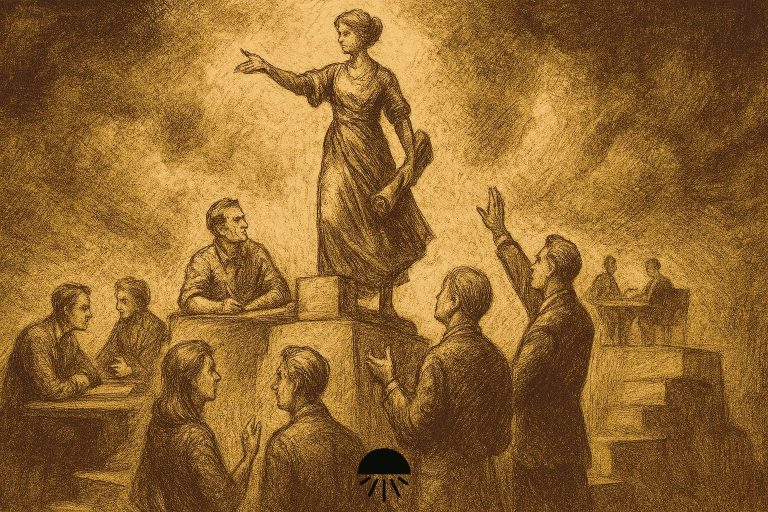
Great leaders don’t just react — they design. The difference between a leader who survives complexity and one who thrives in it comes down to one fundamental skill: the ability to see the big picture without ever losing grip of the critical details that make vision a reality.

The Essence of Strategic Leadership
Strategic thinking forms the foundation of impactful leadership. It’s about maintaining a clear view of the big picture while mastering the tactical execution needed to realize that vision. Leaders who successfully balance long-range goals with immediate action create exceptional value — not just for their organizations, but for every stakeholder in their orbit.
This balance isn’t merely about being visionary. It’s about making deliberate decisions that align team efforts with overarching objectives — day after day, meeting after meeting, decision after decision. Strategy without execution is fantasy. Execution without strategy is chaos.
“Strategy is about making choices, trade-offs; it’s about deliberately choosing to be different.” — Michael Porter, Harvard Business School
The true power of strategic thinking extends beyond planning. It requires seamlessly integrating vision with action, keeping your team aligned with both. Exceptional leaders develop the ability to “zoom in and zoom out” — maintaining sight of long-term aspirations while remaining firmly grounded in the daily work that brings those aspirations to life.
Understanding Strategic Thinking
At its essence, strategic thinking is the capacity to comprehend the complete landscape and make decisions that drive future success. It involves aligning everyday operations with long-term goals and understanding how each action contributes to broader strategic objectives. Leaders who excel can decompose complex goals into manageable, actionable steps that consistently deliver value — creating clarity where others see only complexity.
Strategic thinkers possess a unique ability to anticipate market shifts, identify emerging opportunities, and recognize potential challenges before they become crises. They understand that strategy isn’t static — it’s a dynamic framework that evolves as circumstances change. This adaptive mindset allows them to pivot when necessary while keeping core objectives in focus.
The most effective strategic thinkers also understand something more subtle: they know that the map is not the territory. Plans are tools, not mandates. Real strategic intelligence is the capacity to hold your plan lightly enough to adapt, while holding your purpose tightly enough to stay the course when everything around you shifts.

Three Principles for Strategic Excellence
The Strategic Leader’s Triad
These three principles separate leaders who are merely busy from leaders who are genuinely effective. Internalise all three — they are not optional.
- Vision-Guided, Execution-Focused. Connect daily decisions to long-term aspirations. Communicate how immediate tasks contribute to broader goals. Regularly revisit and refine your vision as you execute. The clearest indicator that a team lacks strategic alignment? When people don’t understand why the work matters — only what needs to be done.
- Data-Informed, Adaptively Responsive. Base decisions on meaningful metrics and insights. Remain flexible enough to adjust when evidence suggests a new approach. Develop systems for continuous feedback and rapid course correction. Data without a decision framework is just noise. Strategy without data is guesswork.
- Value-Driven, Not Activity-Centered. Measure success by outcomes and impact, not by tasks completed. Prioritize initiatives that deliver meaningful results. Ruthlessly eliminate or delegate activities that don’t contribute to strategic objectives. Busy is not the same as productive. Motion is not the same as momentum.
Harmonizing Vision with Detail
One of the most common leadership failures isn’t a lack of vision — it’s the inability to translate vision into a rhythm of action that actually moves things forward. The gap between where you want to go and where you are is filled not by inspiration alone, but by structured, consistent execution habits.
Cultivating Your Strategic Mindset
Developing strategic thinking capabilities is a journey that requires intentional practice and deliberate habit-building. It doesn’t happen by accident. The leaders who think most strategically are the ones who have built daily practices that force them to zoom out even when the pressure of the moment is pulling them in.
Regularly step back from day-to-day operations to consider broader market trends, competitive landscapes, and emerging opportunities.
Actively pursue perspectives that challenge your assumptions and reveal blind spots in your thinking. Homogeneous feedback loops produce brittle strategies.
Regularly explore multiple possible futures and prepare contingency plans. Strategic readiness is not about predicting the future — it’s about preparing for its range.
Schedule dedicated thinking time to evaluate progress, refine approaches, and realign efforts with strategic priorities. Protect it like a board meeting.
The Competitive Advantage of Strategic Thinking
In markets where products are increasingly commoditized and talent is globally mobile, the one truly sustainable competitive advantage is the quality of strategic thinking within your leadership team. Organizations that invest in building this capability at every level — not just in the C-suite — outperform their peers in agility, innovation, and long-term value creation.
Research from McKinsey consistently shows that companies with strong strategic capabilities generate returns 2–3 times higher than their industry peers. But the benefits extend beyond financial performance. Teams led by strategic thinkers report higher engagement, greater clarity of purpose, and significantly lower decision fatigue. When people understand the “why” behind their work, the “how” becomes dramatically more efficient.
Consider the contrast between a reactive organization and a strategic one. In a reactive organization, every quarter brings a new set of crises, pivots, and fire-fighting exercises. In a strategic one, disruptions are anticipated, options are pre-evaluated, and the team moves with disciplined confidence even in uncertainty. The difference isn’t luck or talent — it’s the sustained, intentional practice of strategic thinking embedded in the culture.

Your Path Forward
Strategic thinking is not reserved for those at the top of an org chart. It is a muscle that every leader, at every level, can develop. The most powerful move you can make today is to carve out even thirty minutes a week of uninterrupted strategic reflection — not for problem-solving, but for pattern-recognition and opportunity-spotting.
Ask yourself: Are the activities that consumed my attention this week aligned with our three most important strategic priorities? If the answer is uncertain, that uncertainty itself is your most important strategic insight.
Start there. Build from there. And lead — not just with your calendar, but with your vision.
🧠 Leadership Reflection
How can you apply strategic thinking to your current responsibilities — maintaining balance between the big picture and daily implementation? Consider specific examples where better alignment between daily activities and strategic goals would create breakthrough value for your team.
If this article gave you a new lens for your leadership journey, consider supporting the work that makes it possible. Every coffee counts. ☕
☕ Buy Me a Coffee