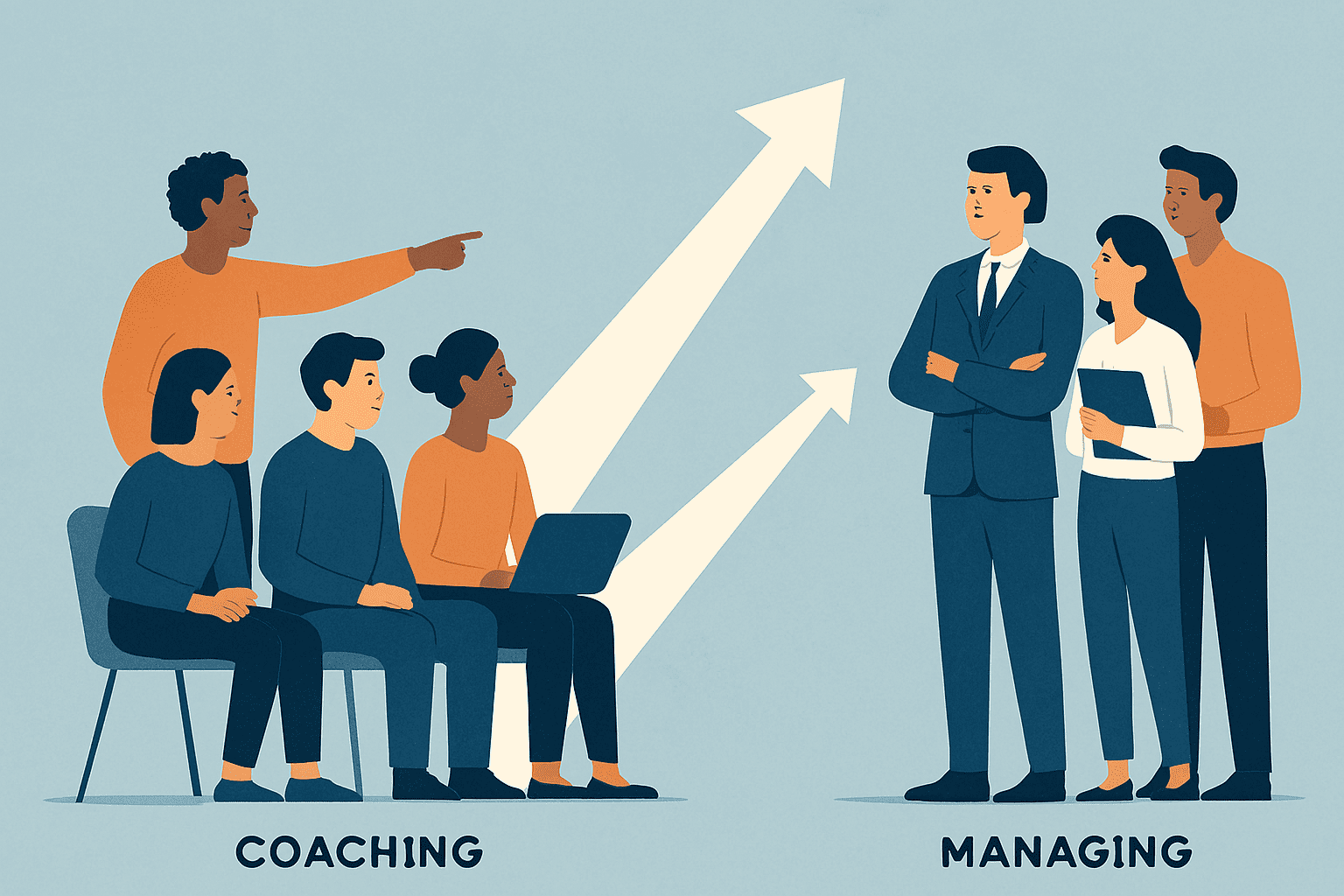
In the contemporary organizational landscape, a fundamental leadership misconception persists: the conflation of management with coaching. This categorical error undermines organizational potential, suppresses talent, and inhibits sustainable growth. It’s time to examine the distinction — and what’s truly at stake.

The Limitations of Management-Centric Leadership
Traditional management methodologies serve essential organizational functions through control mechanisms, performance monitoring, and KPI frameworks. These structures, while necessary components of organizational architecture, constitute an incomplete leadership paradigm. They optimize for the short term at the expense of something more valuable: the adaptive capacity and intrinsic motivation of the people doing the work.
Consider this fundamental distinction: management optimizes existing systems; coaching catalyzes transformative potential. One maximizes what is already in motion — the other creates motion where there was none. Both have their place, but organizations that overindex on management protocols while neglecting coaching dimensions inevitably optimize for efficiency metrics at the expense of sustainable capability development.
“Management is doing things right; leadership is doing the right things — and coaching is helping others discover what the right things are for themselves.”
- Reactive posture
- Task optimization
- Present-focused problem-solving
- Establishes operational parameters
- Implements corrective measures
- Secures behavioral compliance
- Dependency-creating
- Proactive stance
- Human development
- Future-oriented capability building
- Facilitates identity evolution
- Cultivates developmental trajectories
- Engenders psychological commitment
- Autonomy-generating
Empirical Evidence from Organizational Exemplars
This is not theoretical. The organizations that have made the deliberate shift from management-centric to coaching-oriented leadership have produced some of the most remarkable performance turnarounds in recent business history. The data is clear, compelling, and increasingly difficult to ignore.
Google’s landmark internal research initiative fundamentally challenged conventional leadership assumptions. Their rigorous analysis revealed a counterintuitive conclusion: technical proficiency was subordinate to coaching capability as a determinant of leadership effectiveness.
Satya Nadella’s strategic pivot from a “know-it-all” to “learn-it-all” cultural paradigm integrated coaching methodologies throughout leadership hierarchies. This epistemological shift generated remarkable outcomes across the organization.

The Transformative Inquiry Framework
The most powerful lever a leader can pull is not authority — it is the right question. Questions that generate inquiry activate cognitive autonomy. They shift the conversation from “here’s what to do” to “what do you think we should do?” — and in that shift, something profound happens: the other person becomes an agent, not a recipient.
🎯 Coaching Questions That Unlock Potential
If these questions create discomfort in your current leadership practice, you’ve identified a critical development opportunity.
- What constitutes personal excellence within your developmental trajectory?
- What specific support would catalyze your progression to enhanced capability states?
- What organizational challenge would you address given sufficient autonomy and psychological safety?
- What decision-making process would you apply here?
- What’s getting in the way of the results you want to create?
- What would you do if you knew you couldn’t fail?
Implementation Framework for Reflective Leadership Practice
The shift from managing to coaching is not an event — it’s a practice. It requires sustained intentionality, especially in the moments when the instinct to direct and control is strongest. Here is a practical framework for beginning this transition in your own leadership context:
The Essential Question
Management proficiency establishes organizational reliability. Coaching mastery enables organizational transformation. For leaders committed to developing self-sustaining teams with distributed decision authority, this represents an inflection point requiring recalibration of leadership methodologies.
| Dimension | Managing | Coaching |
|---|---|---|
| Primary Goal | Task completion | Human development |
| Time Orientation | Present-focused | Future-oriented |
| Success Metric | KPIs and deliverables | Capability growth + outcomes |
| Communication Style | Directive | Inquiry-based |
| Leader’s Role | Expert and authority | Facilitator and partner |
| Team Dynamic | Dependent on leader | Autonomous and self-directed |
| Long-Term Effect | Operational efficiency | Organizational resilience |
🔑 The Fundamental Question
Are you directing execution processes — or are you catalyzing evolutionary potential? Management processes alone provide insufficient adaptive capacity for future organizational requirements. Coaching provides the necessary developmental infrastructure. Which are you building?
Further Exploration
The coaching literature is rich, credible, and deeply practical. For leaders ready to go deeper, the following bodies of work are foundational: Carol Dweck’s work on growth mindset and its organizational applications; Google’s Project Oxygen research and its findings on effective leadership; Satya Nadella’s transformation story at Microsoft; Sir John Whitmore’s GROW model as a foundational performance coaching framework; and the emerging body of research on adaptive leadership and organizational resilience.
Each of these will reward the investment of your attention. None of them are theoretical exercises. They are tools built from real organizational crucibles — and they work.
This work is free because it should be accessible to every leader who needs it. If it’s helped you think differently about how you lead — keep the conversation going with a coffee. ☕
☕ Buy Me a Coffee